
How SOA OS23 Supports Modern Software Development
Introduction
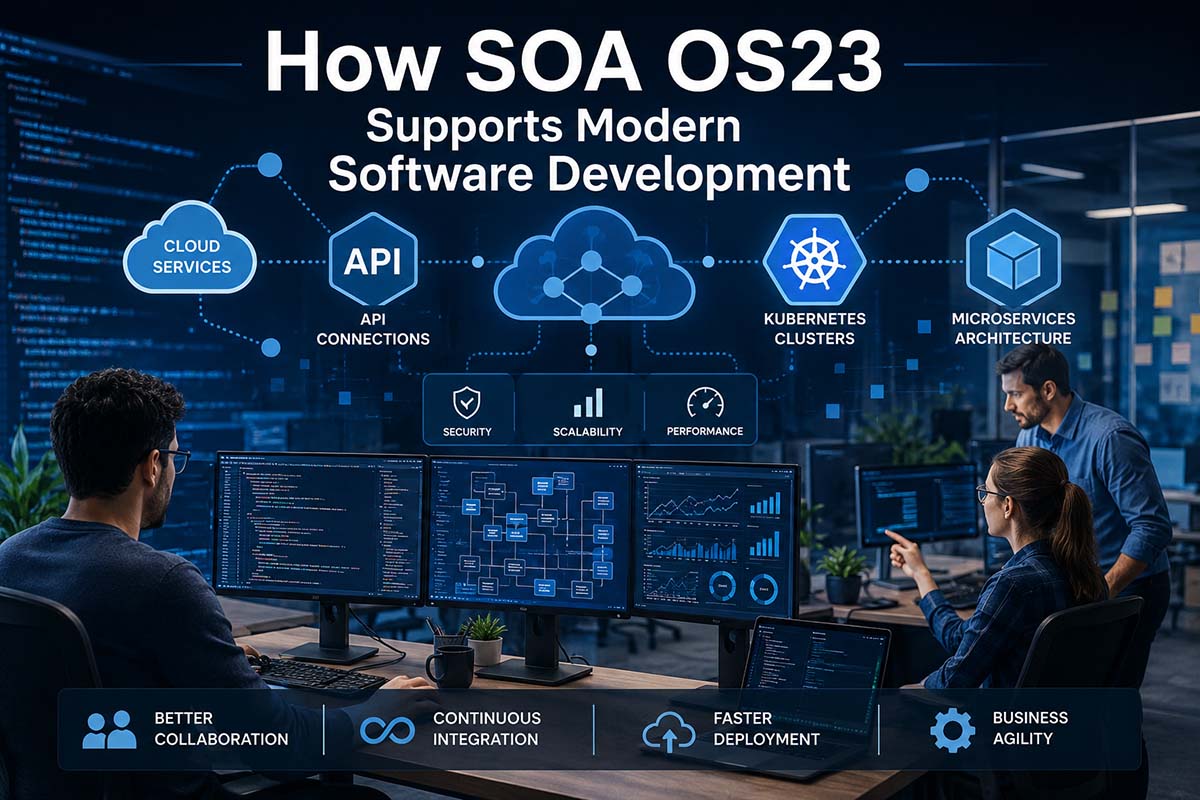
As software systems become more complex, organizations need architecture that supports flexibility, scalability, and long-term growth. SOA OS23 represents a modern approach to service-oriented architecture by combining proven design principles with cloud-native technologies, APIs, automation, and distributed applications. Rather than replacing existing architectural concepts, it builds upon them to help development teams create applications that are easier to maintain, expand, and integrate. Understanding this approach can help businesses make better technology decisions while preparing for future software demands.
Understanding SOA OS23
Service-Oriented Architecture (SOA) has been part of enterprise software for many years. It introduced the idea of building applications from reusable services that communicate through well-defined interfaces. This reduced duplication, improved interoperability, and simplified integration between different business systems.
Modern software environments, however, have changed significantly. Organizations now rely on cloud platforms, containers, APIs, continuous deployment, and artificial intelligence. SOA OS23 reflects these modern development practices by adapting traditional service-oriented principles to today’s technology landscape.
Instead of relying on tightly connected enterprise applications, developers can design independent services that communicate securely and efficiently while remaining easy to update without affecting the entire system.
Why SOA OS23 Matters for Modern Software Development
Modern software projects rarely consist of a single application. Businesses often operate dozens or even hundreds of connected systems serving customers across web, mobile, and cloud platforms.
This architectural approach helps organizations manage that complexity through several important advantages.
Better Scalability
Applications built around independent services can scale only the components experiencing high demand. Instead of expanding an entire application, development teams allocate resources where they are actually needed.
For example, an online shopping platform may increase the capacity of its payment service during holiday sales without changing inventory or customer account services.
Faster Development
Development teams can work on different services simultaneously.
This parallel workflow reduces bottlenecks and allows faster software releases while minimizing conflicts between development teams.
Easier Maintenance
Smaller services are easier to understand, update, and test.
If a problem occurs, engineers can isolate and fix one service without disrupting the entire platform.
Greater Flexibility
Organizations frequently integrate third-party software, cloud services, and internal business applications.
A service-oriented design simplifies these integrations through standardized APIs and communication protocols.
Key Technologies That Complement SOA OS23
Today’s software architecture depends on several supporting technologies that work together to improve efficiency.
Cloud Computing
Cloud platforms allow organizations to deploy services globally while reducing infrastructure management.
Applications can automatically scale as workloads increase or decrease.
API-First Development
Modern applications expose functionality through APIs.
This enables web applications, mobile apps, internal tools, and external partners to communicate consistently.
Containerization
Containers package applications together with their dependencies.
This ensures services behave consistently across development, testing, and production environments.
Popular container platforms include Docker and Kubernetes.
DevOps Automation
Continuous Integration and Continuous Deployment (CI/CD) pipelines automate software delivery.
Automation helps development teams release updates more frequently while maintaining reliability.
Artificial Intelligence
AI-powered monitoring tools detect performance issues before users experience them.
Machine learning also improves resource allocation, predictive maintenance, and operational efficiency.
SOA OS23 in Enterprise Environments
Large organizations often operate software developed over many years.
Replacing every application at once is rarely practical.
Instead, companies gradually modernize their systems by introducing new services while allowing existing software to continue operating.
This gradual modernization provides several benefits:
- Lower migration risk
- Reduced downtime
- Better investment protection
- Improved system interoperability
- Easier cloud adoption
Industries including finance, healthcare, manufacturing, logistics, and retail commonly use service-oriented architectures to manage large-scale operations involving multiple business applications.
SOA OS23 and Microservices
One common question is whether service-oriented architecture and microservices compete with one another.
The reality is that they share many principles while serving slightly different purposes.
| Service-Oriented Architecture | Microservices |
|---|---|
| Focuses on reusable enterprise services | Focuses on independently deployable small services |
| Often supports large organizational systems | Commonly powers cloud-native applications |
| May use centralized governance | Usually emphasizes decentralized ownership |
| Integrates multiple enterprise applications | Optimizes rapid development and deployment |
Many organizations combine both approaches depending on project requirements.
SOA OS23 reflects this practical balance by encouraging modular services while embracing cloud-native development techniques.
Common Business Use Cases
Many organizations benefit from service-oriented software architecture in practical ways.
E-commerce Platforms
Online retailers connect inventory systems, payment gateways, shipping providers, customer accounts, and recommendation engines through independent services.
Healthcare Systems
Hospitals integrate patient records, appointment scheduling, laboratory systems, billing, and insurance platforms while maintaining secure communication.
Financial Services
Banks connect payment processing, fraud detection, customer management, loan systems, and regulatory reporting through standardized services.
Manufacturing
Manufacturers integrate supply chain management, inventory, production scheduling, quality control, and analytics platforms.
Government Services
Public agencies improve digital services by connecting multiple departments while maintaining security and compliance.
Challenges Organizations Should Consider
Although modern service-oriented architecture offers many benefits, successful implementation requires thoughtful planning.
Service Governance
As the number of services grows, organizations need consistent standards for security, documentation, monitoring, and version control.
Security
Each exposed service creates potential security risks.
Authentication, authorization, encryption, and API management become essential components of the architecture.
Monitoring
Distributed systems generate large amounts of operational data.
Organizations need centralized logging, tracing, and performance monitoring tools to maintain visibility.
Team Coordination
Independent development teams require clear communication and shared architectural guidelines to avoid unnecessary complexity.
Best Practices for Successful Adoption
Organizations considering this architectural model should follow several proven practices.
Design Around Business Capabilities
Services should represent meaningful business functions rather than technical components.
Keep Services Independent
Each service should have clear responsibilities with minimal dependencies.
Prioritize API Quality
Well-designed APIs improve long-term maintainability and simplify future integrations.
Automate Testing
Automated testing ensures services remain reliable as applications evolve.
Monitor Continuously
Real-time monitoring helps identify performance issues before they affect users.
Document Everything
Clear documentation makes collaboration easier for developers, administrators, and future project teams.
Future Trends
Software architecture continues evolving alongside advances in cloud computing and artificial intelligence.
Several trends are expected to influence enterprise development over the coming years:
- AI-assisted software operations
- Event-driven architectures
- Serverless computing
- Edge computing integration
- Stronger API security
- Greater observability through distributed tracing
- Platform engineering for developer productivity
Organizations that build flexible service-oriented systems today will be better prepared to adopt these innovations tomorrow.
Learning More About Service-Oriented Architecture
Developers interested in service-oriented principles can explore the official resources published by the OASIS Open standards organization, which develops widely adopted standards for enterprise integration and service-oriented technologies.
These resources provide valuable background on interoperability, service standards, and enterprise architecture best practices.
FAQs
Is SOA OS23 the same as traditional SOA?
No. It builds on traditional service-oriented architecture while incorporating cloud-native technologies, APIs, automation, and modern deployment practices.
Can small businesses benefit from this architecture?
Yes. Even smaller organizations can improve flexibility and scalability by designing modular applications that are easier to maintain and expand.
Does SOA OS23 replace microservices?
No. Many organizations use both approaches together because they address different architectural needs while sharing similar design principles.
Which industries benefit the most?
Finance, healthcare, retail, logistics, manufacturing, government, and SaaS companies commonly use service-oriented architectures to support complex business operations.
Conclusion
Modern software development requires architectures that support flexibility, integration, scalability, and continuous innovation. By combining established service-oriented principles with cloud-native technologies, automation, APIs, and modern deployment strategies, SOA OS23 provides a practical framework for building resilient enterprise applications that can adapt to changing business needs while remaining easier to maintain and expand.


